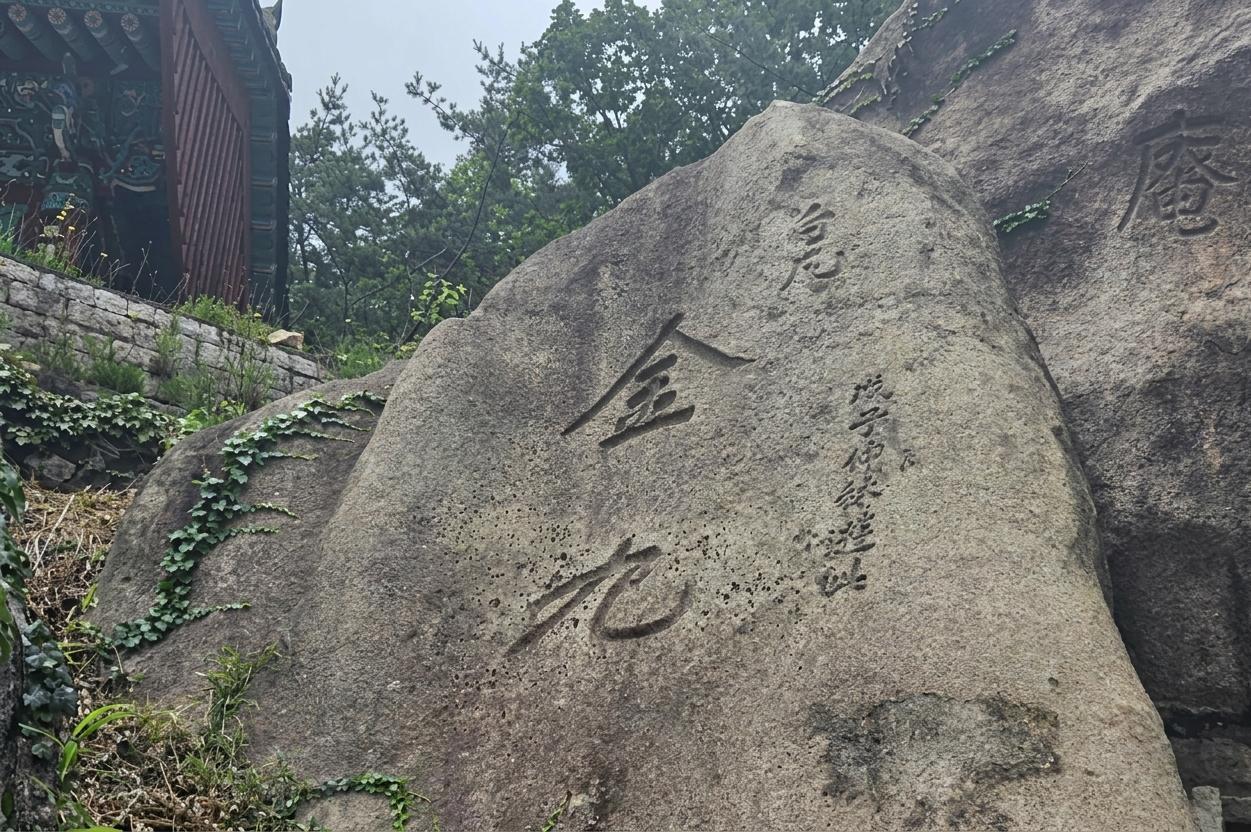
After Korea’s liberation from Japanese colonial rule, independence leader Kim Koo visited Seokguram Hermitage in Bukhansan National Park. At this location, where he took refuge before going into exile in Shanghai, he reflected on the past and left a carved inscription reading, “At Seokguram, Kim Koo, who visited this place in the autumn of 1948.” His calligraphy, reflecting his longing for Korean independence, remains vivid on the giant rock. On the eve of the 81st National Liberation Day, the Korea National Park Service on Friday highlighted the historical legacy left by those who fought to restore Korea’s sovereignty and achieve independence. A natural boulder below Cheonwangbong Peak in Jirisan National Park, measuring 4.2 meters wide and 1.9 meters high, holds a 392-character rock inscription. Composed by late Joseon-era scholar Muk Hui and written in calligraphy by Kwon Ryun, the inscription was carved into the rock on July 1, 1924. The text invokes the power of Mount Jiri and the majesty of Cheonwangbong Peak to repel foreign invaders in hopes of a brighter era. A rock at Baegunda